After gaining independence in 1947, the Archaeology Department was established in 1951 based on the recommendations of a committee formed under the chairmanship of Dr. Sampurnanand, the then Education Minister of Uttar Pradesh. The department was created with the aim of conducting archaeological surveys, preserving ancient sites and monuments, publishing related research, and raising public awareness on these matters. Dr. Krishna Dutt Bajpai was appointed as the Archaeological Officer of this department. The department's office was initially established in a building in the Arya Nagar locality. Dr. Krishna Dutt Bajpai made commendable contributions to the field of archaeology within a short span of 18 months. However, in 1953, the department was dissolved, and its responsibilities were transferred to the State Museum in Lucknow. In the year 1958-59, the Archaeology Department was re-established as an independent entity. However, until 1962, its functions were carried out by an Archaeological Engineer, followed by an Archaeological Assistant until 1965. It was only in 1965, with the appointment of an Archaeological Officer, that the department began operating with greater certainty and effectiveness. In 1974, the position of Archaeological Officer was elevated to that of Director. The department's office operated from the State Museum in Lucknow and the ninth floor of Jawahar Bhawan until 1981-82. It was later relocated to the Roshan-ud-Daula Kothi in Kaiserbagh. As the department came under the jurisdiction of the Culture Affairs Department, it was renamed the "Uttar Pradesh State Directorate of Archaeology." In order to conduct systematic studies of the archaeology in mountainous regions and to preserve monuments, a unit was established in the 'Garhwal' region in 1979-80, which was later relocated to Almora. During the 1990s, regional units were set up in Pauri and Jhansi, and over the past five years, additional units have been established in Agra, Gorakhpur, Varanasi, and Allahabad.
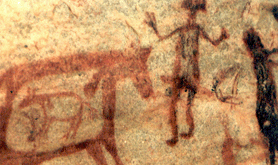
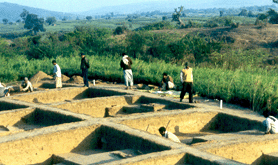
To further accelerate archaeological activities in the state, the Government of Uttar Pradesh, through its Culture Department, on August 27, 1996, re-designated the Uttar Pradesh State Directorate of Archaeology as the "Uttar Pradesh State Archaeology Department" and declared the Director of the State Directorate of Archaeology as the independent Head of the Department. Over the past three decades, the department has conducted numerous archaeological surveys and excavation campaigns across the state. At the Directorate level, systematic archaeological campaigns were conducted across various regions of undivided Uttar Pradesh, including the Himalayan region, the Vindhya plateau, Baghelkhand, Bundelkhand, the Naimisharanya area in central Uttar Pradesh, and the Musanagar region in the Lucknow and Kanpur Dehat divisions. These campaigns brought to light approximately 150 painted rock shelters in the northern Vindhya region and uncovered evidence of human activity dating back 45,000 years in the Yamuna River valley, particularly from the Kalpi area. Additionally, in the Saryupar region of the Middle Ganga Valley, the earliest evidence of rice cultivation, dating back to the second millennium BCE, was discovered at Lahuradewa. Excavations at Malhar in the Chandauli district and Rajanala in the Sonbhadra district have established the antiquity of iron, dating back to approximately 1700-1800 BCE. Numerous protohistoric sites, ancient temples, statues, and pottery remnants were uncovered during archaeological surveys, shedding significant light on the archaeological heritage of Uttar Pradesh. Results from various archaeological campaigns have been published in the annual research journal *Pragdhara*. Over the past fifteen years, *Pragdhara* has established a distinct position not only in Indian archaeology but also in global archaeology.
Through various survey campaigns conducted periodically by the Uttar Pradesh State Archaeology Department, numerous significant archaeological remains have been uncovered from different regions of the state. Notably, over a hundred painted rock shelters in Mirzapur and Sonbhadra have provided new insights into the study of rock art. In addition, several important archaeological sites have been revealed, including Rajanal, Loosa, and Lekhaiya in Sonbhadra district; Kater and Musanagar in Kanpur Dehat district; Bamansuval, Navdeval, and Kapileshwar Mahadev in Almora district; Paithani Shiva Temple in Pauri Garhwal; Thangaon Temple in North Kashi; and Indra Vaikunth in Tehri district. These sites have provided new directions for archaeological research both within the state and nationally.